
This blog article almost didn’t happen; I almost did not make it to 20 years of self harm recovery. While I did make it to today, May 24th, it doesn’t feel like a victory. All my previous milestone posts have been about conquering challenges and coming out stronger. I can’t write that today.
If you’ve followed my story, it’s pretty obvious the last few years have been rough. After being chronically ill for years, we discovered toxic mold hidden behind our walls. (You can read about that story here.) We weren’t able to stay in our home, and we couldn’t remove the mycotoxins from our belongings. We lost everything, and insurance covered nothing. But that wasn’t the hardest part.
My Hardest Trial
The hardest part of the past couple years was my son developing Pediatric Acute-onset Neuropsychiatric Syndrome (PANS) from toxic mold exposure. This is a type of autoimmune encephalitis, sometimes also referred to as a neuro-immune condition. To put it simply, a child’s immune system is weakened until a trigger pushes it past the breaking point. That trigger may be a virus, bacteria, tick-borne pathogen, or environmental toxin. PANDAS is similar, except it is triggered by Strep infections. For my son, the trigger was mold.
Once past the breaking point, the immune system stops being able to identify the intruder and instead attacks the brain, particularly the basal ganglia, resulting in motor tics, vocal tics, OCD, ADHD, oppositional defiance, night terrors, insomnia, incontinence, loss of muscle control in hands, severe separation anxiety, restrictive eating, sensory issues, and regressions in math, reading, and handwriting. These symptoms increase during or after an acute illness. That increase is called a flare.
I’ve lived through a home explosion when I was 12. I suffered sexual assault from a peer in 8th and 9th grades. I lost my home and my own health in my 30s. But nothing, absolutely nothing, has been as painful as watching my child suffer.
The PANDAS/PANS Physicians Network reports “high levels of stress, anxiety, depression, and burden, with the average burnout score exceeding the threshold for caregiver burnout.” The Journal of Clinical Psychiatry says that 50% of PANDAS/PANS caregivers exceed the burnout threshold and the need for respite care. To put it in plain English: Many PANS parents are pushed well past the breaking point.

Progression and Regression
I went far past my threshold and fell off that cliff last January. My son had been doing so well. We bought a house, got settled, had a lovely little Christmas, and life felt like maybe we were returning to normal after two years of instability.
Then Christmas evening, my son started exhibiting a motor tic. Within a few hours, he had a fever. After a couple weeks of fighting whatever flu-like illness he had, the brain inflammation escalated. Incontinence returned with a vengeance, sometimes causing accidents every five minutes. Separation anxiety became intense, and I couldn’t leave his sight without sending him into a panic attack.
Imagine getting dressed, going to the bathroom, or taking a shower when you have a boy in the next room feeling like he is dying without you. Imagine making dinner, hands covered in raw meat as you roll meatballs, and your child suddenly needs the bathroom right now, and he can’t go without you. And there is no respite at night, because your child can’t stay asleep. It’s all day, every day, with no break, ever.
In addition, one of my son’s symptoms was a somatic cough. This is partially a tic, which is an involuntary movement. It’s partially OCD, because he feels like something bad will happen if he can’t cough when he hears someone else cough. This OCD tic was so deeply ingrained that it would occur even if someone coughed while he slept. The more he heard coughing, the more it trained his brain, and the worse the OCD tic became. Unfortunately, my husband had a cough, so almost all the caregiving was on me. We hid out in my room for three weeks with a noise machine on. I barely left his side. I researched until my eyes ached.
By the time he was well enough to venture outside the house, we both were having panic attacks trying to adjust to life in public.
Exceeding Burnout
To have gained so much progress and have it all crumble away in a moment and to be so unable to get it back knocked me off my feet. I felt like someone yanked the rug out from under me and knocked the air out of my lungs, like someone shoved me underwater and held me there while all I could do was flail with nothing to put my feet on to give me leverage to push back. I didn’t know how to fight anymore, and I felt like that made me a terrible mother.
The thing with PANDAS/PANS is that because it is rarely diagnosed, not many people know about it, including physicians. It’s very difficult to seek emergency care for a child in a PANDAS/PANS flare. And the people in your circle can’t empathize. It’s not their fault; they haven’t lived it. But because they don’t understand, their actions and words can sometimes be dismissive.
- “Oh yeah, the sniffles are going around. He’ll be fine.”
- “I’ve never heard of PANS before. I don’t think it’s real.”
- “He doesn’t have oppositional defiance disorder. Have you considered his behavior is due to your parenting style?”
First, the PANS parent shuts down and keeps to herself. Then she starts to wonder if everyone else is right. She gaslights herself. She starts to believe them. Psychology Today has an excellent article how gaslighting oneself is common in PANS parents.

The Crash
One night last January, those gaslighting thoughts got too loud. I should have told my husband I was not okay, but asking for help feels wrong when you’re a caregiver.
I was too upset to eat. While my family ate dinner, I took a razor and sat in my room. I just wanted to let the pressure inside me leak out a little. My old thoughts of needing punishment for my shortcomings took over my mind. I craved the biochemicals that would make me sleepy and turn off my thoughts. It felt like ending self harm recovery was worth it. I just needed to make sure I did this in a way my husband and especially my children would not find out.
While trying to solve the logistics, something in my mind made me text a long-distance friend familiar with self harm recovery. I told her I couldn’t stop it this time. I honestly did not think she would respond, because I had told her before when I was having bad days. She was used to getting messages like that every few years. But she knew this time was different. She didn’t text me back.
She called me.
My friend reminded me that self harm is Satan’s desire. She reminded me I didn’t belong to that darkness anymore. She spoke the truth over me: I was a child of God, sealed in baptism, dead to sin and alive to Christ. My wounds don’t heal the hurt inside; only Jesus’ wounds do that.
Fighting Back
It became an all-out war in my mind. It was like part of me had already committed to carrying out self harm, and I didn’t have the control to simply say no. I had this vivid image in my mind of kneeling in mud, clinging to a cross made of rough, splintered wood, and I felt like Satan’s demons were pulling on my legs, trying their damndest to yank me away. I knew I had to snap out of it and break their hold.
In my early days of self harm recovery, my therapist gave me a list of alternatives to self harm, and change in temperature is what I responded to most. If I was in a public place, I used to excuse myself to the bathroom and run cold water over my wrists. I remember one difficult night in college, I went for a walk in the rain.
I fumbled my way into the shower and turned it on the coldest setting. The phone was on speaker, on the shelf with the soap. My friend was talking me through. I was in such a mental and spiritual battle, the icy water didn’t register. It poured all over me, but I just kneeled and sobbed and kept repeating out loud that I belonged to Jesus, and He already paid for all my mistakes. My friend repeated it with me.
After a half hour, it finally clicked that I was cold, and I started to shiver. I was grounding, connecting with my surroundings. I heard the water, and I felt my wet clothes clinging to me. My breathing slowed down. Slowly, the lure of the razor dimmed and disappeared. Then I threw up from the intense stress of it all.

I’m Not Alone
I started spending more time in the PANDAS/PANS parent support groups online. And I saw so many parents having similar breaking points. Here are a few quotes:
“My son is a big kid and goes into rages, and I can’t safely manage him. I can’t find inpatient stabilization for PANS kids that aren’t psych wards. I can’t find in-home help.”
“I called a family member for help and said we were in a crisis. That person said it was too overwhelming and wouldn’t come.”
“I feel like I spend my whole life calling providers, driving to appointments: doctor, chiropractor, occupational therapist, psychiatrist.”
“I will do anything, no matter how extreme, to prevent another flare for my child.”
“A doctor today started asking questions that seemed to imply I did this to my child.”
“What do you do when the flares get so bad you no longer want to be a parent?”
“I can’t find a PANS provider who is not booked six months out, and I can’t find one we can afford.”
“What do you do when insurance won’t cover anything and you can’t afford to pay out of pocket? Has anyone had success treating PANS on their own?”
“I’m never going to get help for my child. No one will believe me.”
“The hospital called Children’s Services, and they are suggesting I relinquish custody.”
“I can’t do this anymore. Is there some place I can go where they will take care of my child and give me respite? I don’t want a psych ward; I just want a break for a few days.”
These statements reminded me I wasn’t crazy. I was going through something really, truly hard. I needed to stop gaslighting myself and get help, because my kids depend on me. Financially, my son’s treatment had priority, so I joined a clinical trial for Neuro Emotional Technique, a therapy that helps release stored emotional stress from the body. After a handful of sessions, I felt much better. (You can learn more about NET at sites like NET Mind Body, Balance Chiropractic, and Strata Well.)

Difficulty Finding Support
For those of us suffering poor mental health due to ongoing traumatic circumstances, we don’t necessarily want mental hospitals, talk therapy, or medication. But when we ask for help, those are the options, and sometimes they get forced upon us.
So we stop asking for help.
Even asking friends and family for can hurt. When I first opened up about what our family was suffering, I got a lot of responses like,
“You are mentally ill and need medication.
“Those things can’t be true.”
“Your doctor is wrong. Get a second opinion.”
Let’s face it; dismissive responses are common. A person finally opens up about terrible abuse they suffered as a child, and they are told, “Your family seemed so perfect. Are you sure that happened?”
A woman confides that she was raped and receives the response, “How did you get yourself in that situation?”
Someone’s loved one dies, and they may be told, “Grief goes away with time. Until then, seek therapy.”
Or someone is in dire financial need and gets told, “This, too, shall pass.”
Very few are willing to walk alongside the suffering.
Ways Loved Ones Can Support Mental Health
The suffering need hands-on help. Ways to help a family facing chronic trauma:
- Closest friends and family can read books and do online research to educate themselves on the conditions we are facing and become our advocates.
- Make a resource list of providers and therapies and treatments local to us, understanding we will not be able to take up all your suggestions or may need to try one at a time.
- Make a list of financial resources or start up a fundraiser.
- Bring meals when we can’t cook. (Check for food allergies and diet restrictions.)
- Close family and friends can offer to go to appointments with us to help take notes, be a second listening ear, and be present for emotional support.
- Learn the special needs our child has so you can offer safe childcare. We need a date with our spouses. We need a nap.
- Be present. Cry with us. Acknowledge things aren’t ok right now, and remind us one day they will be.
- Write encouraging cards, letters, even text messages. Remind us we are doing a good job.
If you know someone experiencing ongoing trauma, you don’t have to do all those things. Pick one or two ways to help that fits well with your skillset and personality. I promise it will make a difference. It’s made a difference to me.

The Wound is Where the Light Shines Through
This is possibly my most raw, most transparent post on my journey with self injury recovery. While I may not bear any physical wounds, there are gaping wounds in my heart. I’ve never written about mental health or self harm recovery when it’s a current battle. I almost didn’t write this because I know there will be people who read this and think, “Wow. She’s really lost it. She’s not recovered at all. This girl needs a mental hospital.” I was so afraid of even one person thinking that.
But today, as I drove my son to his treatments, I listened to Switchfoot. The song Where the Light Shines Through came on. It immediately broke through my barriers and softened my war-hardened heart. The lyrics go like this:
Verse 1:
When you’re feeling like an astronaut
Stuck on a planet even time forgot, and
You’re a version of yourself, but you’re not the same
You try to keep the wound camouflaged, and
The stitches heal, but the years are lost, and
Another bottle on the shelf can’t numb the pain
Why’re you running from yourself now?
You can’t run away
Chorus:
‘Cause your scars shine like dark stars
Yeah, your wounds are where the light shines through
So let’s go there, to that place where
We sing these broken prayers where the light shines through–
The wound is where the light shines through
I wanna see that light shining
Brighter than the pain
I decided to head over to Switchfoot’s website to read the story behind the song. It turns out that this song is not rehearsed, polished, or edited. The song on the album is the demo. Jon Foreman describes it as, “Five guys in a room playing a song that they barely know- with joy, abandonment, and mistakes included.”
Where I Am Weak, He Is Strong
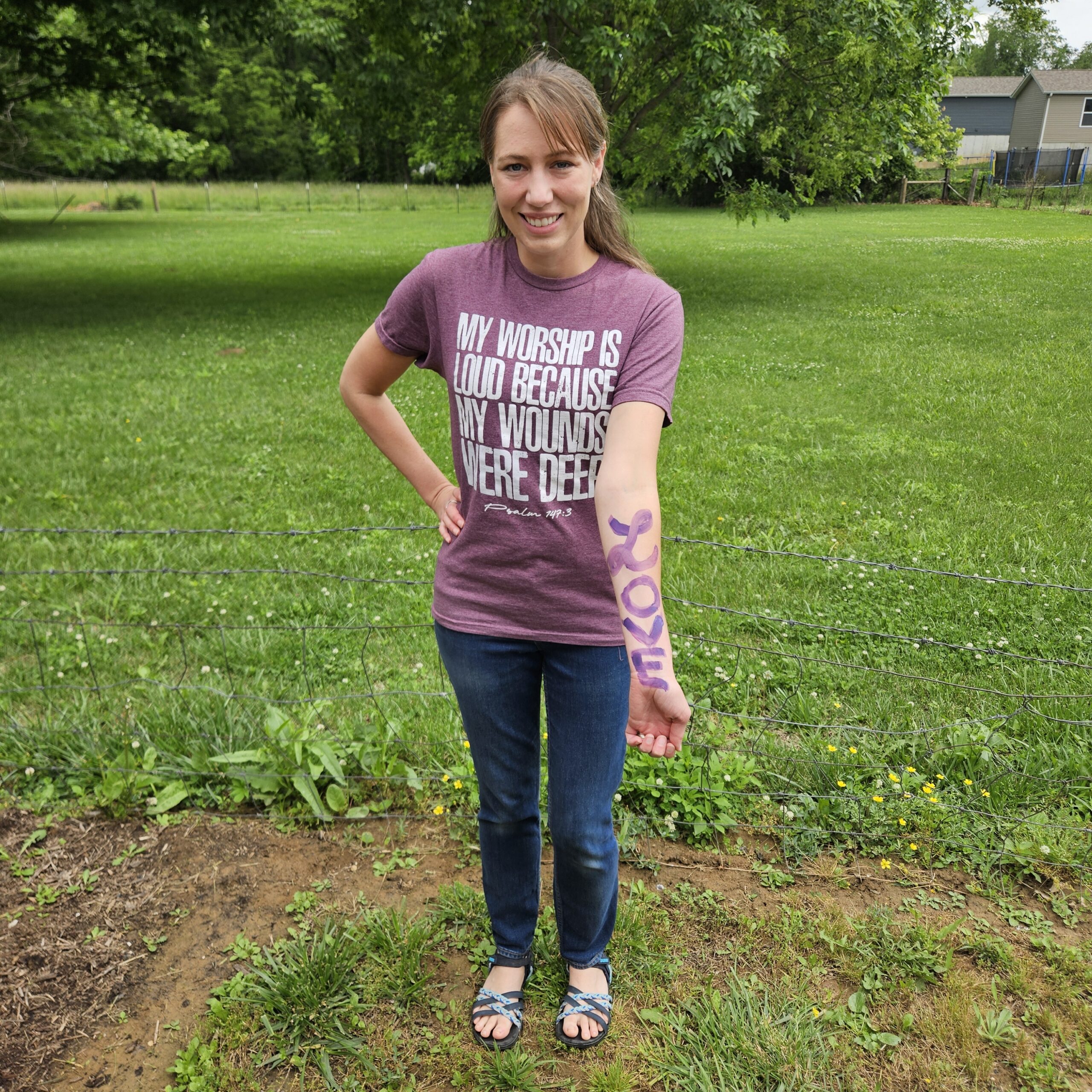
So I wrote this today, exposing all my emotional turmoil, revealing that recovery is not always pretty. Look at my old, faded scars on my arms. They’re symbols of a time I didn’t know how much Jesus loved me, when I didn’t understand He took away the shame of what a boy had done to me. Don’t turn away from the invisible gash in my heart that’s there today. Look at how fractured and feeble I am! Listen to me sing broken prayers. Look at my mess and chaos! Because when you do, you won’t find a strong woman. You’ll see my Savior holding me up. You’ll see Jesus resurrecting me every day, enabling me to care for the precious children He gave me.
Ultimately, it is Christ’s wounds where His Light shines through. Look to Him. Because Isaiah 53:5 is true for me, and it’s true for you. “By His wounds, we are healed.”
